|
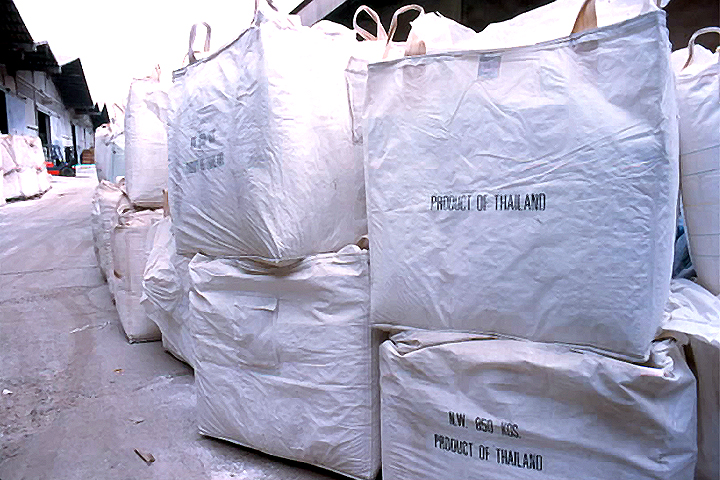
Berkeley International is a
specialist in sourcing products worldwide. |
|
Our contact for tapioca starch
is
John
Eyton |
|
Process of Tapioca Starch Production |
 |
 |
|
|
|
|
One kilogram of tapioca starch requires 4.4 kilograms of fresh cassava
roots at its starch content of 25%.
In Thailand, the large-scale
processing facilities with advanced processing machines and technology
have been replacing those primitive and small-scale factories. According
to the studies, the processing methods could be divided into two
processes; traditional and modern. Their details are as follows: The
traditional process, usually practiced in the small-scale factories,
is able to separate starch from fresh cassava roots by crushing and then
submerging the cassava under the water. The starch made through this
process is inferior in quality. The process of this method has 9 steps
as follows:
- Weigh fresh cassava roots to determine starch percentage.
- Chop out the tails connected along with the roots before putting
in the peeling devices.
- Remove the peel and steep them in the cleansing well.
- Put the clean ones in the chopper and grinder. Grind until they
becomes fine particles and sediment them in the water. In this step,
they appear as the slurry mix of starch, water, and fiber.
- Filter the slurry to separate starch slurry from the fiber,
however, the fiber still has some starch content that can be used as
animal food.
- Sediment the slurry in the wooden pail.
- Dry the wet cake under the sun light on the yard.
- Use the grindstone to grind the completely dried cake.
- Pack in the bag.
|
|
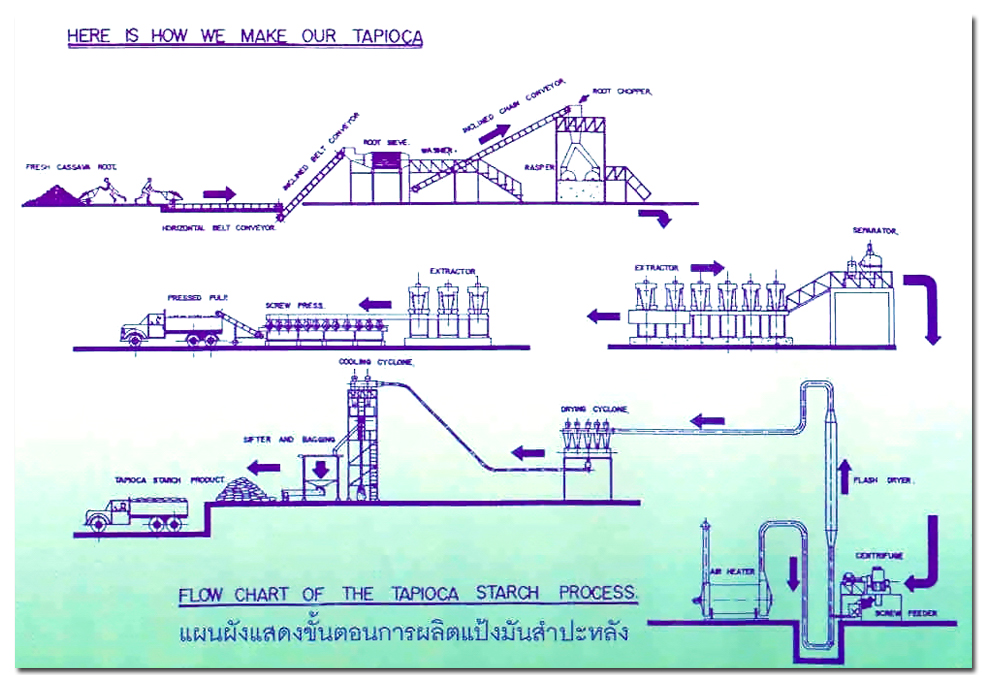
The modern process, practiced in the
large-and-medium-scale factories relies on
numbers of highly efficient equipment and machines; Grinding the starch
with the high-speed Rasper. Then extract the protein by the machine
called “Decanter”. Separated the water by the “Centrifuge”. Dry the cake
in the flash dryer. This process requires only short period of time and
provides superior quality of starch. The process may be described into 8
steps as follows: |
|
|
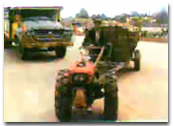 |
1. Weigh the fresh cassava roots to determine the
starch percentage. |
 |
2. Remove sand and impurity in the rotary screener. |
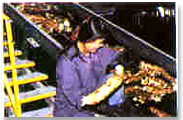 |
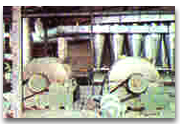
3.
Put it into the peeling-and-cleansing device, then chop out root tails. |
 |
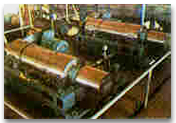
4. Put the fresh clean cassava into the Rasper and
then Decantor to remove protein. |
 |
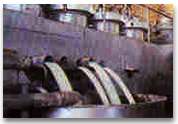
5. Pass the slurry through the screen to remove
fiber. Fiber is sun-dried and sold out for animal feed application. |
 |
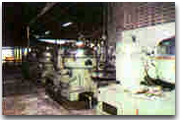
6.
Separate the fine fiber and impurity by “Centrifuge”. |
 |
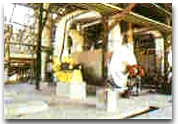
7. Dry out the starch by passing it through the
hot-aired dryer column. |
 |
8.
Pass the starch through the sifter and pack the fine powder into the
sacks for sale. |
|
|
|
|
|
|
|
|
|
|
|
|
|
|
|
|
|
|
|
|
|
|
|
|
|
|
|
|